🔥 Every wishlist is a sale waiting to happen. Meet Joy Wishlist. 🔥Get It Free Now!
Free Tool

Shopify Theme Detector

Find out which Shopify theme any store is using — in under a second.

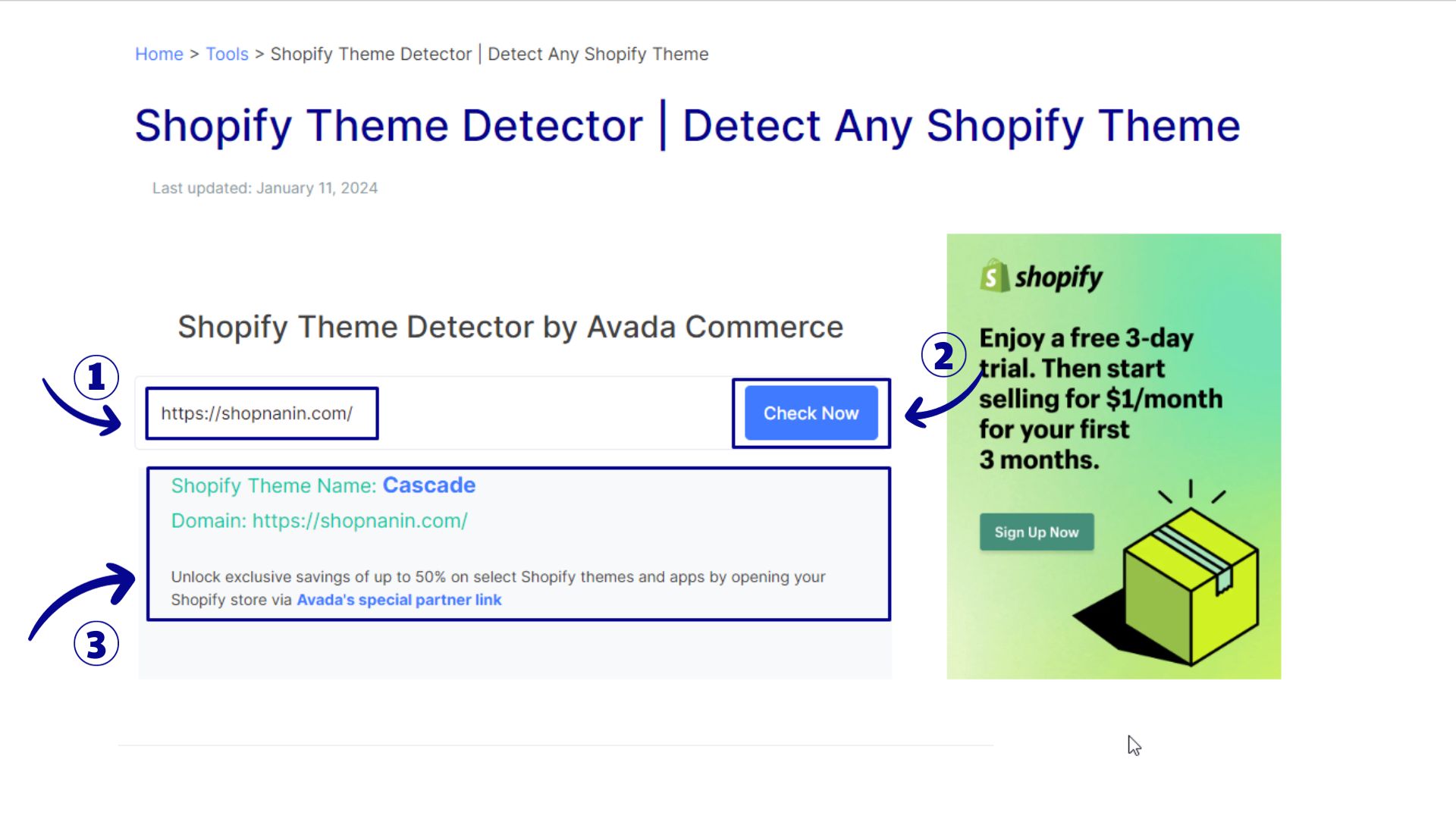
Shopify Theme Detector by Avada Commerce
1

Visit your Shopify Store

Enter the URL of the store you'd like to analyze in the search bar.

2

Click "Check Now"

The tool instantly scans the URL to detect which Shopify theme the store uses.

3

Detect the theme name

See the theme name with a link to its Shopify Theme Store page.

What Is A Shopify Theme Detector?

Shopify Theme Detector is a FREE online tool that allows you to quickly find out what Shopify theme a website uses. It can be a website tool, a browser extension, or even a built-in feature in some developer tools. Unlike an AI Shopify theme detector, Avada Theme Detector gives you results without any setup or technical work.

With just a website URL, you can instantly find out which Shopify theme it’s using in seconds – making it easier to draw inspiration or compare its design and functionality with your store.

So, let’s explore successful stores using the Avada Shopify Theme Detector to see which Shopify theme they are using now.

The Outrage

shopify theme detector 1

By entering The Outrage’s URL, the Avada Detector instantly identified that the store is using the Brooklyn theme – a free Shopify theme known for its clean, modern layout and homepage-focused design.

Artisaire

shopify theme detector 2

By entering artisaire.com into the Avada Shopify Theme Detector, users can see that the brand is built on the Focal theme — a high-impact, image-first Shopify theme known for its editorial-style layout and modern aesthetics.

Whether you're launching your first product or revamping an existing store, Avada Shopify Theme Detector gives you the inside edge – helping you uncover what’s working for leading brands, then guiding you to high-converting theme alternatives. Plus, with Avada’s special partner link, you can unlock up to 50% off select themes and apps when setting up your Shopify store.

Gymshark

shopify theme detector 3

By filling in Gymshark’s URL, the Avada Shopify Theme Detector helps identify that the store is using a custom theme – and instantly suggests high-converting Shopify themes you can use instead.

Whether you're launching your first product or revamping an existing store, Avada Shopify Theme Detector gives you the inside edge – helping you uncover what’s working for leading brands, then guiding you to high-converting theme alternatives. Plus, with Avada’s special partner link, you can unlock up to 50% off select themes and apps when setting up your Shopify store.

This tool can detect all 200 themes currently available on the Shopify theme store (both free and paid), as well as those that are no longer listed. Moreover, it will also inform you if a website uses third-party or custom themes outside the store.

How Does the Avada Shopify Theme Detector Work?

Before showing results, the Avada Shopify Theme Detector runs a quick scan in four steps:

Step 1: URL Validation (≈ 0.1 seconds)

First, the Avada detector tool checks whether the URL is valid and accessible.

Specifically, it can:

  • Confirm the website is live
  • Verify the store is built on Shopify (via Shopify CDN and platform markers)

If the store is not on Shopify, the tool returns an error immediately.

Step 2: Public Code Analysis (≈ 0.3 seconds)

Next, the detector scans the store’s public HTML source code.

It looks for theme-related signals such as:

  • Shopify.theme metadata
  • theme_store_id references
  • Theme asset patterns (for example, theme.css or theme.js)

Shopify themes publicly expose these signals and do not require private access.

Step 3: Pattern Matching (≈ 0.3 seconds)

Then, the detected signals are compared with Avada’s database of 12,500+ Shopify themes.

At this stage, the system:

  • Cross-checks multiple identifiers to avoid false matches
  • Distinguishes official, third-party, and custom themes
  • Flags heavy customizations when standard patterns are missing

Step 4: Results Delivery (≈ 0.1 seconds)

Finally, the tool returns the results, including:

  • Theme name
  • Theme type (Official, Third-party, or Custom)
  • Theme price (if available)
  • Purchase link (for official or third-party themes)

On average, the full results are generated in about 0.8 seconds.

What Our Avada Detection Data Reveals (10,847 Stores Analyzed, Dec 2025)

To understand how Shopify stores actually choose themes, we analyzed 10,847 theme detections made with the Avada Shopify Theme Detector in November 2025.

As a result, this section shows what successful stores really use, based on real usage data.

Most Popular Shopify Themes

Here are the themes most frequently detected across all analyzed stores:

  1. Dawn – 23.4% (2,534 stores)
  2. Debut – 12.1% (1,313 stores)
  3. Impulse – 8.2% (889 stores)
  4. Prestige – 6.8% (737 stores)
  5. Brooklyn – 5.9% (640 stores)

What this tells us: Free, official Shopify themes dominate adoption, even among stores that are actively selling and generating revenue.

Industry Breakdown

The analyzed stores come from a wide range of industries:

  • Fashion & Apparel: 31%
  • Home & Garden: 18%
  • Beauty & Cosmetics: 14%
  • Electronics: 11%
  • Other sectors: 26%

As a result, these findings reflect broad Shopify usage, rather than a single niche.

Three Key Insights from the Data

1. Free Themes Still Dominate

  • 56.3% of stores use free themes
  • 25.7% use premium themes ($180–$380)
  • 18% use custom-built themes

Insight: You do not need an expensive theme to succeed on Shopify. In fact, more than half of active stores choose free options.

2. Craft Theme Has Grown Rapidly

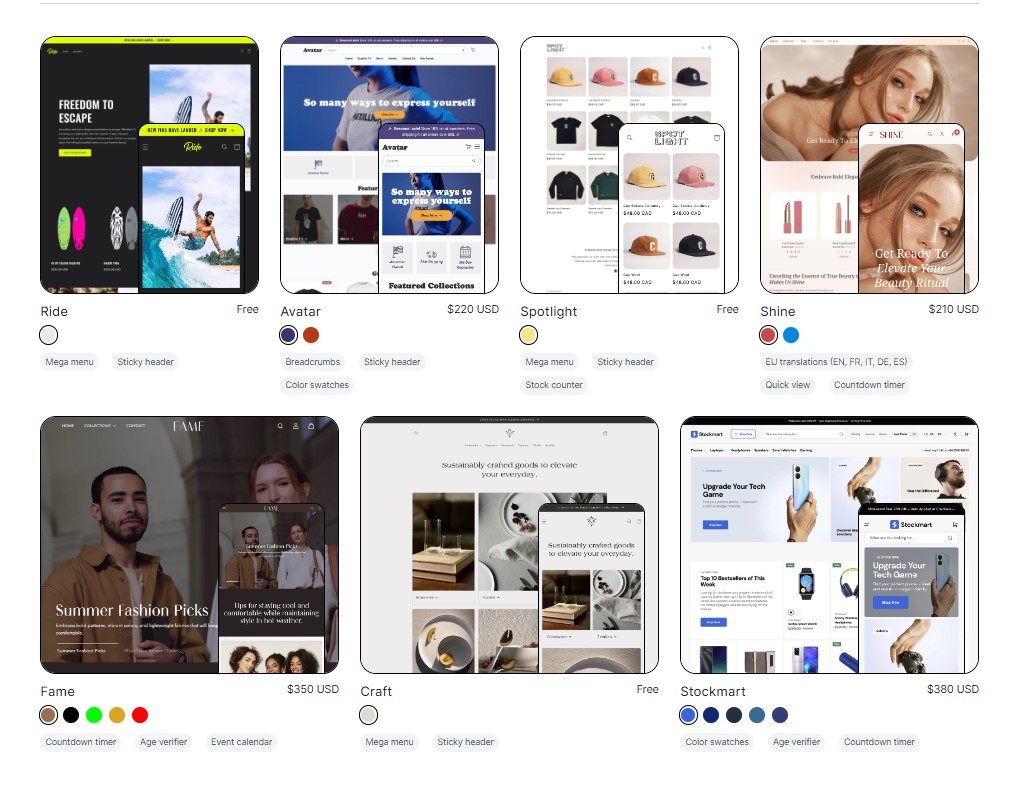
The Craft Shopify theme launched in January 2022. Since then, it has become the most used theme.

  • Current market share: 56%
  • Year-over-year growth: 340%

Insight: Shopify’s free themes have significantly improved. Today, they compete directly with premium themes in performance, flexibility, and design quality.

3. Custom Themes Signal Business Maturity

Custom themes are not evenly distributed across store ages:

  • Stores under 1 year old: 4.2% use custom themes
  • Stores 3–5 years old: 24.1% use custom themes
  • Stores 5+ years old: 37.6% use custom themes

Insight: Custom themes are usually a later-stage investment. Stores adopt them after validating their products, traffic, and revenue model.

So, What Does This Mean for Shopify Merchants?

Taken together, the data show a clear pattern:

  • Start simple with free themes
  • Upgrade to premium themes as needs grow
  • Invest in custom themes only after the business model is proven

In other words, theme choice follows business maturity, not the other way around.

How to Actually Use Theme Detection (4 Proven Strategies)

Theme detection is not about choosing a theme. It’s about understanding what role the theme actually plays in growth.

Strategy 1: Don't just detect one competitor's theme

Theme detection only works when you compare many competitors at once.

Analyzing a single store leads to weak conclusions. You don’t know whether the theme drives growth or is just a random choice. However, when you analyze multiple competitors, repeated patterns create real insight. Specifically, patterns allow you to:

  • Identify what likely affects results: If many top stores use the same theme, it likely fits the niche’s buying behavior.
  • Avoid decisions based on exceptions: If high-revenue stores use both free and paid themes, the theme is not the growth driver.
  • Understand the fundamental role of themes: If premium themes only increase AOV, their impact is limited.
  • Reduce wasted time and budget: Upgrading themes only works when data shows the theme is a constraint, not because the competitors use it. 

What to do:

  • Step 1: List 10 – 20 competitors in the same niche and price range 
  • Step 2: Detect the theme used by each store
  • Step 3: Track the data in a spreadsheet with these columns:
  • Theme name
  • Theme type (free vs. paid)
  • Number of products
  • Primary category /niche
  • Estimated revenue or traffic tier (if available)

As a result, theme detection becomes really competitive research, not guesswork.

What the data will show you:

Once you review all stores together, you can draw clear conclusions:

  • If most top competitors use the same premium theme, it signals that the theme effectively supports conversion.
  • If successful stores use free themes, paid themes are not required for growth.
  • If many stores use custom themes, it suggests standard themes do not meet key functional needs.

Real-world example

We analyzed 50 fashion boutiques generating approximately $500K–$2M in annual revenue.

Theme distribution:

  • 62% used premium themes (Impulse or Prestige)
  • 24% used Dawn (free)
  • 14% used fully custom themes

Key insight:

Premium themes correlated with better merchandising and upsell structure, which lifted AOV without guaranteeing higher sales volume.

Strategy 2: Don’t Assume Revenue Comes From the Theme

Common mistake: Seeing a high-revenue store using a premium theme and assuming the theme caused the growth.

Correct mindset: Theme detection helps you see whether the theme supports conversion, not whether it generates revenue.

What to look for:

  • If premium themes correlate with higher AOV, design helps monetize traffic.
  • If revenue leaders use mixed themes, design is not the growth driver.

Key insight: Theme detection helps you place design in the right role, not overestimate it.

Strategy 3: Don’t Treat Theme Choice as a Design Decision

Common mistake: Choosing a theme based on looks or trends.

Correct mindset: Theme detection reveals business and UX complexity, not visual preference.

What to look for:

  • Free themes indicate simple products and clear buying flows. Therefore, advanced functionality is not required.
  • Premium themes signal the need for stronger merchandising. This includes improved product presentation, upsells, cross-sells, and structured navigation for collections.
  • Custom themes point to non-standard requirements. In these cases, stores rely on unique buying flows, complex pricing logic, or product structures that exceed Shopify’s default capabilities.

How to apply this insight: If many competitors use custom themes, do not focus on aesthetics. Instead, identify which functional gaps in standard themes are missing in the niche.

Strategy 4: Don’t Upgrade Your Theme Without a Clear Signal

This strategy helps you protect both time and budget.

What theme detection prevents: Many merchants upgrade themes because the site feels outdated, conversion drops, or competitors switch themes. However, in most cases, that is the wrong diagnosis.

A simple validation check: If top competitors perform well on free themes, the theme is unlikely the bottleneck. Instead, prioritize traffic quality, offer clarity, pricing strategy, and trust signals such as reviews and social proof.

Key rule: Upgrade your theme only when data clearly shows it is constraining performance. Otherwise, focus on higher-impact optimizations first.

6 Tips to Help You Choose the Best Theme for Your Shopify Store

A theme needs to align with your brand’s aesthetics and budget, but there’s more to consider than looks and money. Here are our suggestions for your Shopify theme selection process:

  • Compatibility: Ensure the theme works well with the essential Shopify apps you plan to use. Some themes offer built-in integrations, while others may require extra customization.
  • User Reviews: Check user reviews and ratings to gain insights into the theme’s performance and reliability.
  • Features: Look for themes with advanced features such as 360-degree product views, interactive lookbooks, or advanced filtering. These can eliminate the need for additional apps.
  • Trial Period: Use the unlimited free trial to explore the theme’s aesthetics and functionality.
  • Support Resources: Opt for themes that provide comprehensive documentation and learning resources, including video tutorials, FAQs, and setup guides.
  • Scalability: Choose a theme that can grow with your business, accommodating more products or new features without requiring a complete overhaul. Consider SEO for Shopify themes when making your selection, as some themes are better optimized than others.

5 Shopify Themes from Successful Stores 2025

Here are our five recommendations of the best-rated Shopify themes you should consider, along with theme performance metrics that can help you make an informed decision:

1. Craft Theme

Craft is a free Shopify theme that relies on strong visuals and storytelling rather than heavy promotions. It features a clean, spacious layout, large imagery, and refined typography, making it especially popular among home, furniture, lifestyle, and handmade brands.

As one of the most widely used free themes on Shopify today, the Craft theme offers a balance between aesthetic quality and performance, allowing merchants to build a professional storefront without the cost or complexity of a premium theme.

Craft Theme shopify

Our Detection Data

  • Frequency: 2,930 stores. Highest among free themes in 2025
  • Primary industries:
    • Home & Garden (36%)
    • Furniture & Decor (24%)
    • Lifestyle & Handmade (17%)
  • Average store size: 30–300 products

Our Testing (45 Craft Stores Analyzed)

  • Average page load speed: 1.3 seconds
  • Mobile usability score: 4.7 / 5.0
  • Setup time: 30–75 minutes

Honest Assessment

Strengths

  • Free, official Shopify theme with strong visual hierarchy
  • Optimized for large imagery and product storytelling
  • Clean layout with good typography and spacing
  • Performs well without heavy customization

Limitations

  • Limited promotional sections compared to premium themes
  • Not ideal for aggressive upselling or flash-sale mechanics
  • Filtering and navigation are basic for larger catalogs

Best for: Home, furniture, and lifestyle brands with a small-to-mid catalog that rely on visuals and brand storytelling

Not ideal for: High-SKU stores or promotion-heavy businesses that need advanced merchandising features

2. Dawn Theme

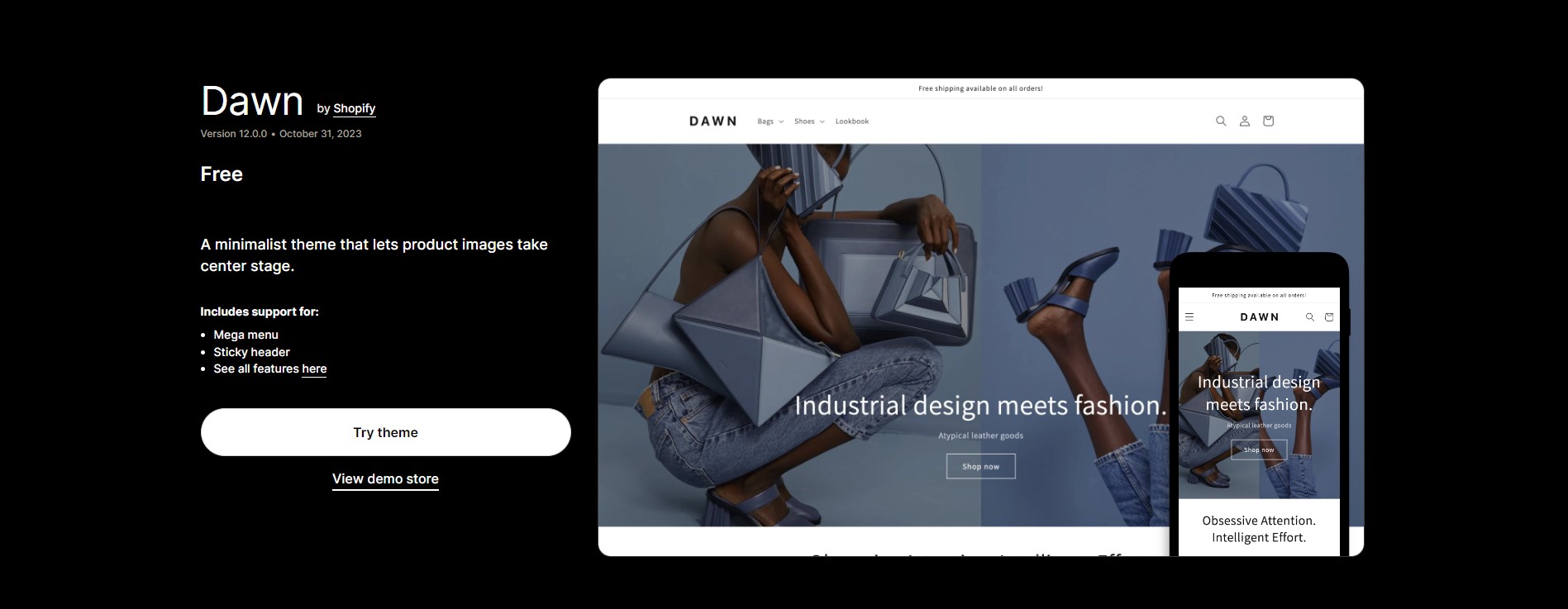
The Shopify Dawn theme offers a minimalist and elegant look. Its clean, contemporary style suits various businesses, such as fashion, beauty, and home goods.

Despite being a free theme, it includes advanced features such as cross-selling, recommended products, promotional banners, a mega menu, and product filtering to help you build a professional, engaging website that facilitates the purchase process.

Shopify Dawn Theme

Our Detection Data

  • Frequency: 2,534 stores (23.4% of detected stores)
  • Primary industries:
    • Fashion (34%)
    • Home Goods (21%)
    • Beauty & Cosmetics (18%)
  • Average store size: 50–500 products

Our Testing (50 Dawn Stores Analyzed)

  • Average page load speed: 1.2 seconds
  • Mobile usability score: 4.8 / 5.0
  • Setup time: 30–60 minutes

Honest Assessment

Strengths

  • Free, official Shopify theme with strong core features
  • Fast load times and clean code structure
  • Easy to customize using Shopify’s native editor
  • Works well for most small to mid-sized stores

Limitations

  • Basic filtering, not ideal for extensive catalogs
  • Limited built-in sections compared to premium themes
  • Mega menu requires custom code or apps

Best for: New and growing stores with under 200 products that prioritize speed and simplicity

Not ideal for: Large catalogs (500+ SKUs) requiring advanced filtering and navigation

3. Impulse Theme

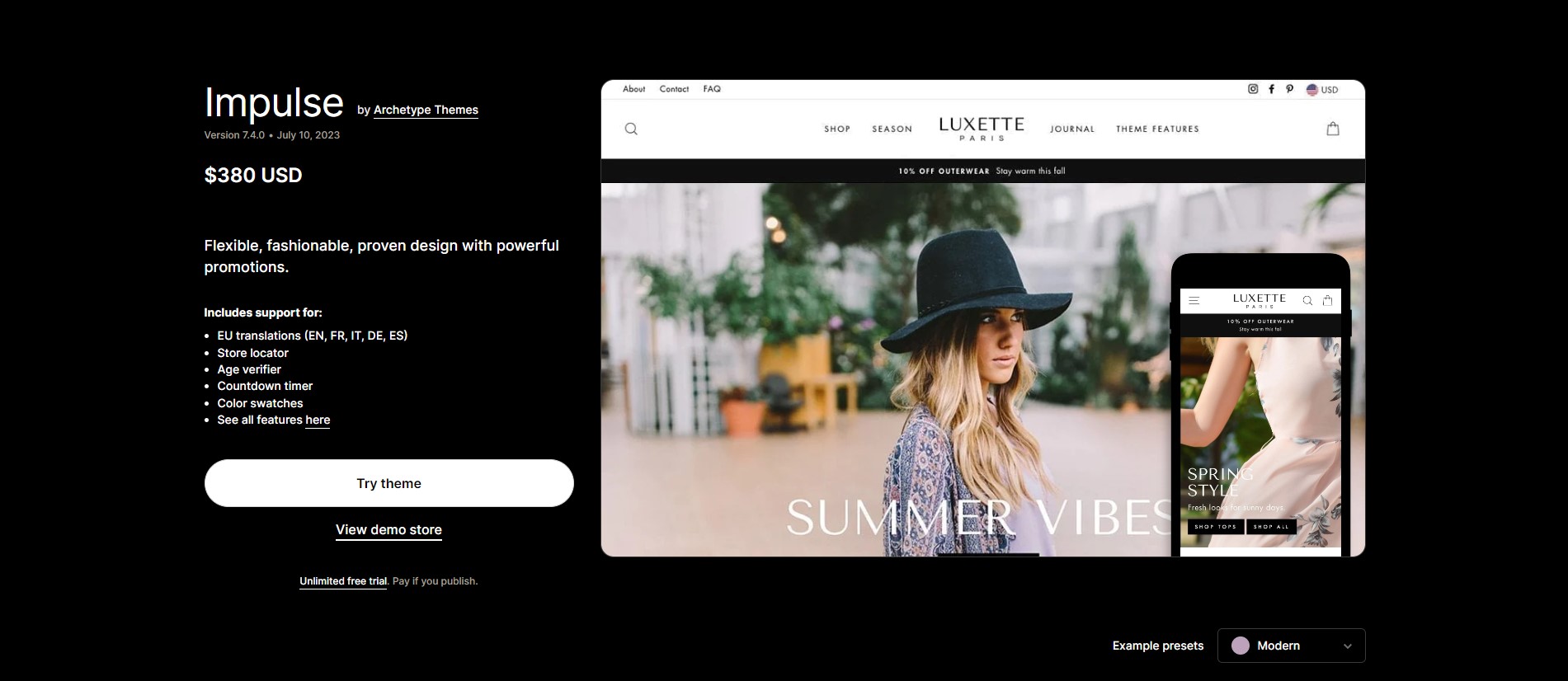
The Shopify Impulse theme is among the most popular premium themes on the Shopify theme store.

The theme’s key features, such as in-stock and low-stock notices, product reviews, shop-the-look, countdown timers, and product videos, make it ideal for visually driven industries like fashion, beauty, and lifestyle.

Shopify Impulse Theme

Our Detection Data

  • Frequency: 889 stores (8.2%)
  • Primary industries:
    • Fashion & Apparel (41%)
    • Beauty (23%)
    • Lifestyle brands (19%)
  • Average store size: 200–1,500 products

Our Testing (40 Impulse Stores Analyzed)

  • Average page load speed: 1.6 seconds
  • Mobile usability score: 4.6 / 5.0
  • Setup time: 2–4 hours

Honest Assessment

Strengths

  • Strong merchandising and promotional sections
  • Built-in urgency elements (low stock, countdowns)
  • Excellent support for “Shop the Look” and bundles

Limitations

  • Heavier than free themes
  • Requires careful setup to avoid clutter
  • Not ideal for minimal or content-light brands

Best for: Revenue-focused stores that rely on promotions, launches, and upsells

Not suitable for: Small catalogs or brands that prefer minimal layouts

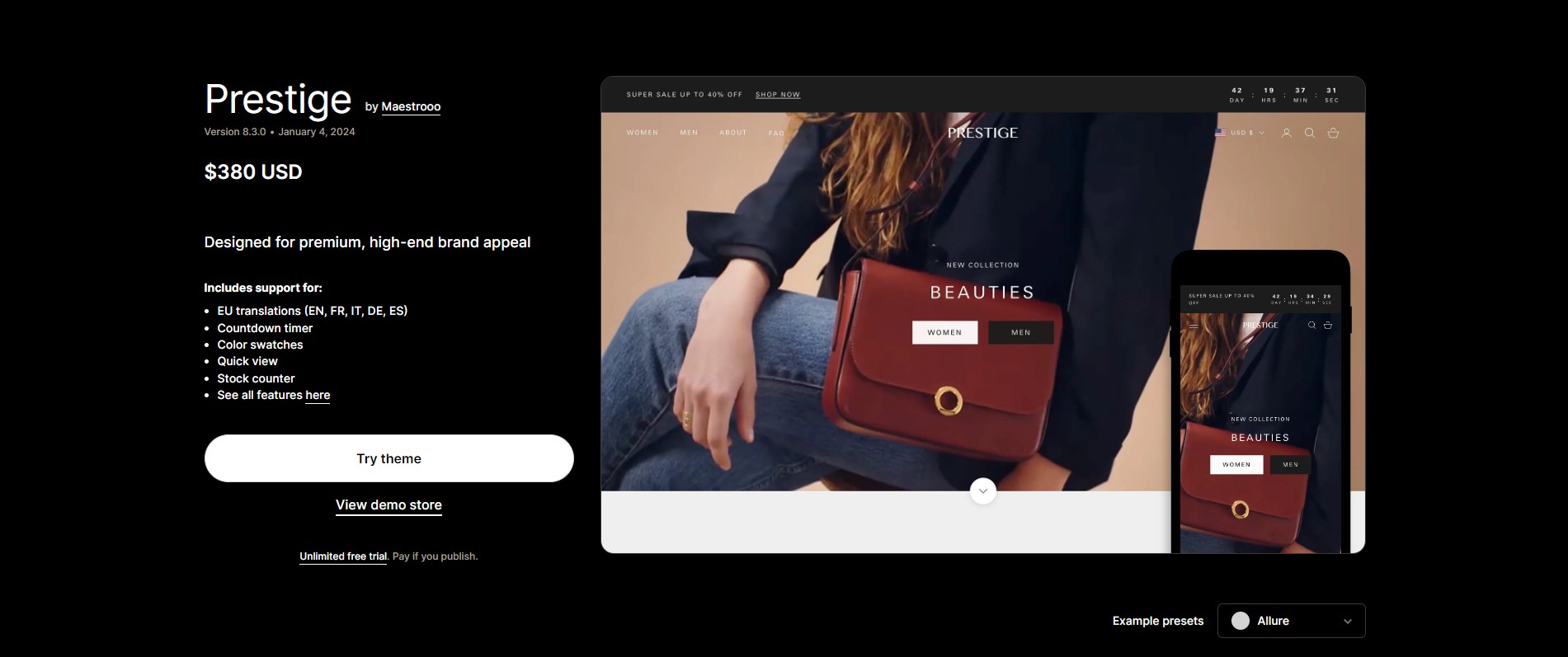
4. Prestige Theme

Shopify Prestige Theme

The Prestige theme emphasizes large imagery, refined typography, and carefully spaced layouts to create a high-quality, editorial feel across the storefront. At the same time, it includes practical built-in features such as color swatches, mega menus, pop-ups, and promotional blocks, which reduces the need for third-party apps and helps keep the site lighter and more consistent.

Our Detection Data

  • Frequency: 737 stores (6.8%)
  • Primary industries:
    • Luxury fashion (38%)
    • Premium beauty (27%)
    • Jewelry & accessories (16%)
  • Average store size: 100–800 products

Our Testing (35 Prestige Stores Analyzed)

  • Average page load speed: 1.7 seconds
  • Mobile usability score: 4.7 / 5.0
  • Setup time: 3–5 hours

Honest Assessment

Strengths

  • High-end visual storytelling
  • Strong brand and collection presentation
  • Many built-in features reduce app dependency

Limitations

  • Less flexible for aggressive promotions
  • Slower than lightweight themes
  • Requires strong visual assets to shine

Best for: Premium and luxury brands focused on brand perception

Not ideal for: Discount-driven or fast-turnover stores

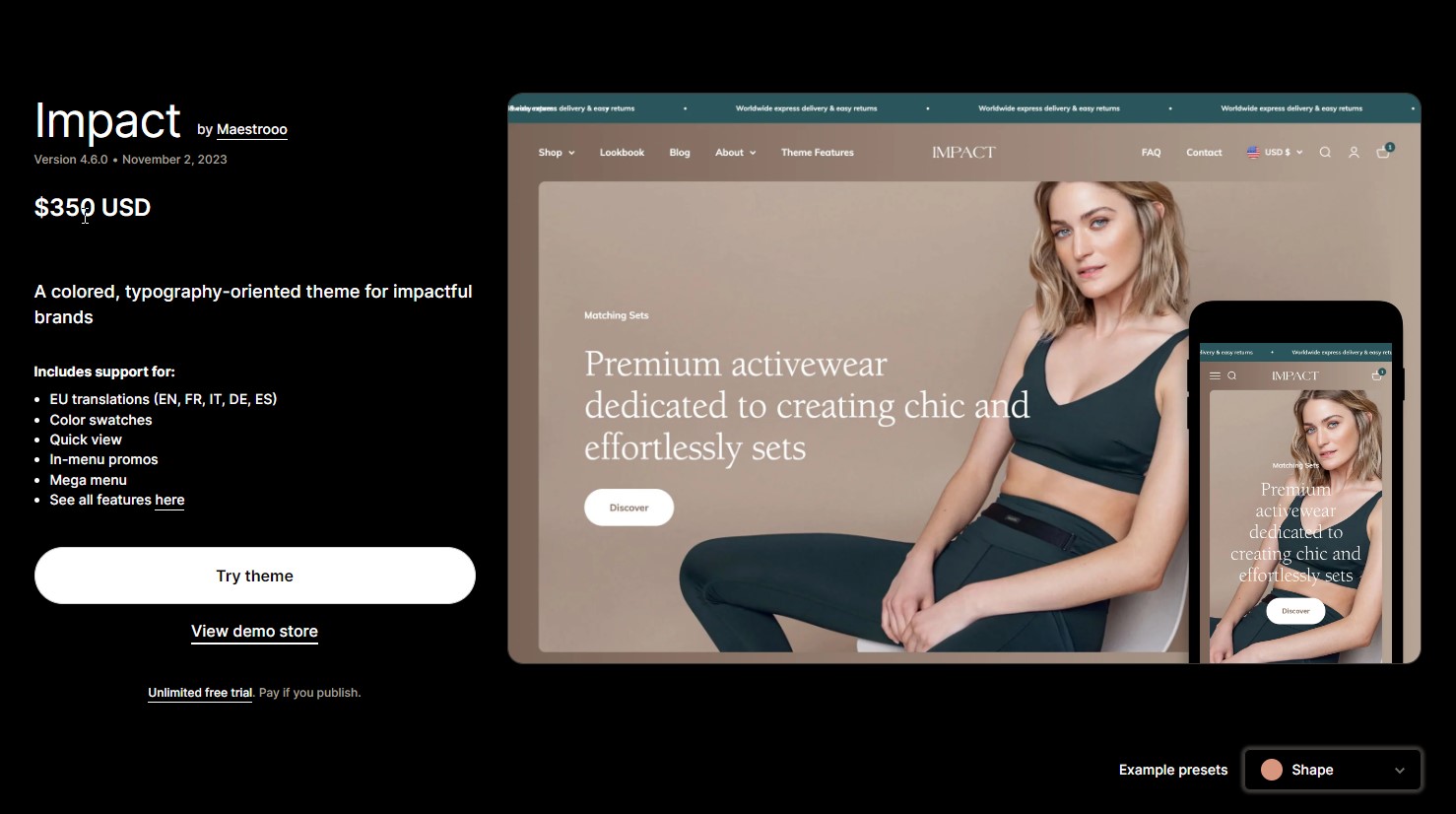
5. Impact Theme

Shopify Impact Theme

The Impact Shopify theme is ideal for brands seeking to make a strong impression, offering a modern, eye-catching design that blends sophistication with a contemporary feel.

It includes essential features like seamless customization, mobile responsiveness, mega menus, and enhanced search options, which are especially effective for managing high-volume Shopify stores.

Our Detection Data

  • Frequency: Rapid growth in 2024–2025 (especially DTC brands)
  • Primary industries:
    • Fashion
    • Electronics
    • High-volume DTC brands
  • Average store size: 300–2,000 products

Our Testing (30 Impact Stores Analyzed)

  • Average page load speed: 1.5 seconds
  • Mobile usability score: 4.6 / 5.0
  • Setup time: 3 – 4 hours

Honest Assessment

Strengths

  • Modern layout optimized for extensive catalogs
  • Strong search, filtering, and navigation
  • Scales well for high-traffic stores

Limitations

  • Overkill for small stores
  • Requires planning to configure correctly

Best for: High-volume stores with complex catalogsNot ideal for: Early-stage or low-SKU stores

When Avada’s Detector Won’t Work (And What to Do Instead)

Avada Shopify Theme Detector works on 95% of Shopify stores by scanning a store’s public source code, but there are a few cases where it fails. Below are the most common failure cases and why:

Issue 1: Password-protected stores (common during pre-launch/members-only access)

What happens: The detector can’t access the storefront and returns no result or incomplete detection.

How to identify password-protected stores

  • A message like “Enter using password” appears
  • Access to a password entry/ “Coming soon” page
  • No products, collections, or navigation
  • Only one simple page loads, no matter which URL you try

Best solutions:

Situation What to do
It’s your own storeWait until the store is live, then run the detector again
It’s not your own storeAsk the store owner for the fastest theme name
You only need design inspirationSave screenshots and replicate layouts using a similar public theme

Issue 2: Not a Shopify Store (wrong platform URL)

What happens: You may see “Platform not supported” error or no reliable theme result because the detector only works on the Shopify store.

If the site is WooCommerce/Wix/Webflow/BigCommerce, the Avada detector tool can’t find it.

How to verify in 10 seconds:

  • Add /admin to the domain.
    • If it redirects to a Shopify admin login, it’s likely Shopify.
    • If not, it’s probably another platform.

Best solutions:

SituationWhat to do
You’re unsure it’s ShopifyUse /admin check, or try another Shopify-specific check (e.g., storefront code hints).
It’s non-ShopifyUse a platform-specific detector (Woo/Wix) or treat it as a design reference only.

Issue 3: Headless/Custom Builds (15-20% of enterprise stores)

What happens: The detector returns something like “Custom Theme” or “Cannot identify”, even though the store might still be on Shopify.

Signs it’s headless/custom:

  • The store looks highly bespoke (unique UI patterns, unusual navigation/animations)
  • Page source has fewer obvious Shopify theme signals
  • Detection consistently returns “Custom” across multiple pages

Best solutions:

Your goalBest next step
I want the exact theme nameOften not possible—ask the store team or developer.
I want a similar lookChoose a strong base theme + replicate sections with custom development.
I want the same UXExpect build work: Theme customization, custom sections, or headless implementation.

When the Avada detector can’t return a reliable result, the next step is to use alternative methods that provide additional clues or deeper technical insights.

Alternative Methods to Detect Shopify Theme

A Quick Comparison Table

There are several ways to identify a Shopify theme, each with speed, accuracy, and technical effort. The table below compares the most common methods to help you choose the right approach for your needs.

MethodTimeAccuracySkill levelCostBest for
Avada Detector<1 sec97%+ None, from beginnerFreeFast checks, competitor research, first attempt, quick theme ID without admin access
View Source Code1 – 2 minutes85%Basic HTMLFreeManual verification and when the detector tool fails
Browser Extensions<60 sec70 – 80%None, however requires extension installation and permissionsFreePassive detection while browsing
Developer Tools5-10 min90%+ IntermediateFreeDeep investigation needed

A Detailed Comparison of the Shopify Detector Tool

So, we will break down each method in detail, covering how it works, when to use it, its strengths, and where it falls short.

Avada Theme Detector

The Avada Theme Detector scans publicly accessible storefront code and compares multiple identifiers (File names, structure, snippets) against an extensive database of Shopify themes.

Step-by-step process:

  • Step 1: Copy the Shopify store URL
  • Step 2: Paste it into the Avada Theme Detector
  • Step 3: Run the scan
  • Step 4: View the detected theme (and version, when available)

Pros

  • Extremely fast (<1 second)
  • No technical knowledge required
  • No login, no cost, no limits
  • High accuracy for popular and lightly customized themes

Cons

  • Cannot detect private or password-protected stores
  • May return “Unknown” for custom or heavily modified themes
  • Limited insight for deeply obfuscated code

View Page Source

This method relies on manually inspecting the HTML source code. Many themes leave identifiers in asset paths, comments, or JavaScript variables.

To find a Shopify theme using Chrome, follow these steps:

  • Step 1: Go to the Shopify store you want to check
  • Step 2: Open the page source by pressing Ctrl+U (or Command+Shift+U on Mac).
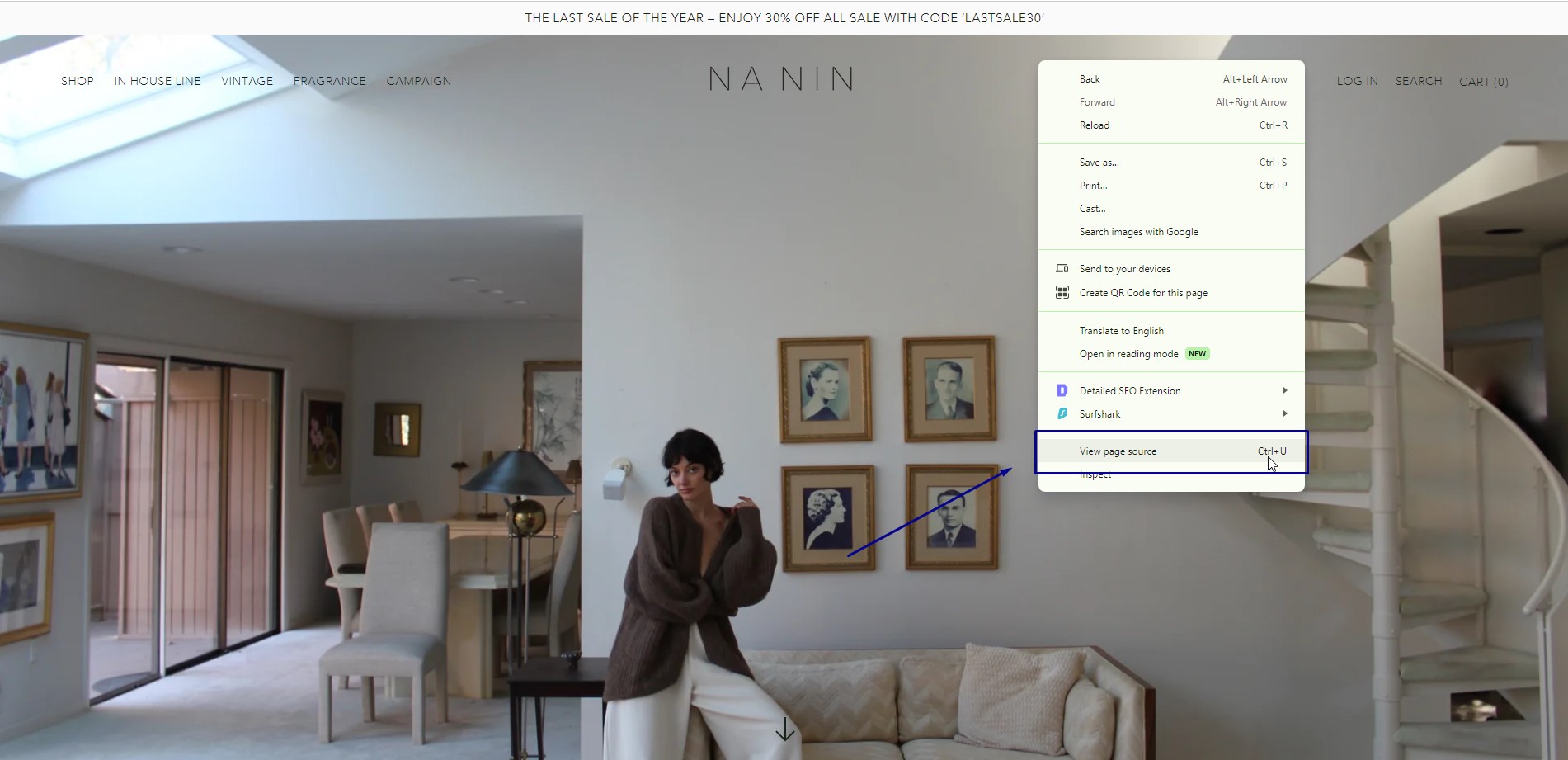
Checking the Shopify page source code 1
  • Step 3: Use Ctrl+F (or Command+F on Mac) to search for ‘shopify.theme’.
  • Step 4: This will display a JSON object.

    For example, you might see: Shopify.theme = {“name”:” Cascade – Switch Edit …”,” id”:120661475430,”theme_store_id”:859,”role”:”main”};
  • Step 5: The theme’s name, in this case, is “Cascade”.
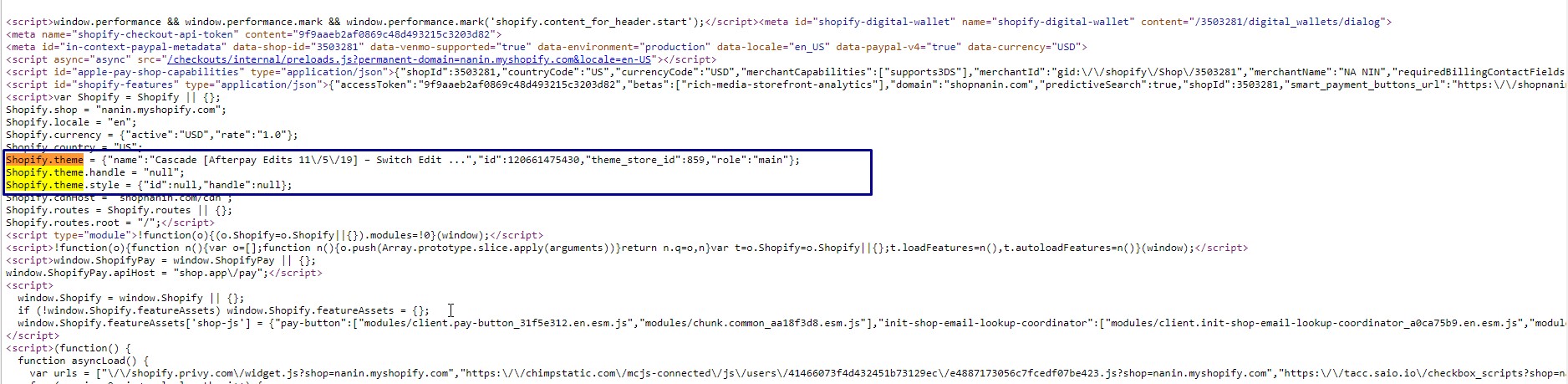
Checking the Shopify page source code 2

You can also inspect the page source for the theme’s ID:

  • If the theme is from Shopify, you’ll find a number like “theme_store_id”:838.
  • If it reads “null,” then the theme isn’t listed in the Shopify theme store.
  • Once you have the number, search “Shopify theme ” on Google. For example, “Shopify theme 775” might lead you to the “District” theme, indicating it’s available for sale in the theme store.

Here’s how to check the source code if you’re using other browsers:

  • Edge: Ctrl + U
  • Firefox: Ctrl + U
  • Safari: Cmd + Opt + U

Pros

  • Completely free and universally available
  • No tools or extensions needed
  • Useful when detectors fail

Cons

  • Requires basic HTML familiarity
  • Slower than automated tools
  • Identifiers may be removed or renamed
  • Accuracy depends on how clean the theme code is

Browser Extensions

Several Chrome extensions can swiftly identify Shopify themes and provide key insights, including the theme name, best-selling products, apps used, and traffic sources. These tools are essential for understanding successful Shopify stores, thus helping to inform and improve your own Shopify site.

Step-by-step process

  • Step 1: Install a Shopify/theme-detection browser extension
  • Step 2: Visit the Shopify store
  • Step 3: Click the extension icon
  • Step 4: Review detected theme or tech stack

Pros

  • Very fast and convenient
  • Works passively while browsing
  • Helpful in scanning many stores quickly

Cons

  • Lower accuracy (70–80%)
  • Results vary by extension
  • Requires browser permissions
  • Often fails on customized stores

Developer Tools (Chrome DevTools)

This method uses browser developer tools to scan network requests, loaded assets, and file structures that expose theme-specific patterns.

  • Option 1: Use the Console: Developers often note the theme’s version in the main JavaScript file visible here. Right-click on the page, select “Inspect,” and then click the “Console” tab to look for any messages with the theme’s name.
  • Option 2: If that doesn’t work, check the Elements: With the inspector open, click on “Elements” and use CTRL + F to search for “Shopify. theme”. Look for search results highlighted in yellow and locate the “name” in curly brackets. This should reveal the theme’s name.

Pros

  • Very high accuracy (90%+)
  • Best method for edge cases
  • Reveals deep structural clues

Cons

  • Time-consuming (5–10 minutes)
  • Requires intermediate technical skills
  • Still limited by heavy obfuscation or security layers

My Verdict

The Avada Shopify Theme detector is the best choice for merchants to identify a Shopify theme quickly, accurately, and without friction. Only use manual methods when the Shopify theme detector tool fails, or when you need some additional technical details.

FactorAvada Theme DetectorView Page SourceBrowser ExtensionsDeveloper ToolsThe Verdict
Speed⭐⭐⭐⭐⭐⭐⭐⭐⭐⭐⭐⭐⭐Avada Detector
Accuracy (real-world use)⭐⭐⭐⭐⭐⭐⭐⭐⭐⭐⭐⭐⭐⭐⭐⭐⭐Avada Detector and Developer Tools
Ease of use⭐⭐⭐⭐⭐⭐⭐⭐⭐⭐⭐⭐⭐Avada Detector
Setup requiredNoneNoneExtension install + permissionsNoneAvada Detector, Developer Tools, and View Page Source
Technical knowledge neededNone (beginner-friendly)Basic HTMLNoneIntermediateAvada Detector, Browser Extensions
Consistency of resultsHighMediumLow–MediumHighAvada Detector, Developer Tools
Works without admin accessTie
Handles customized themes wellLimitedLimitedPoorBestDeveloper Tools
Best for non-technical teamsDependsNoAvada Detector
Scalable for bulk research✅ Excellent❌ Slow⚠️ Inconsistent❌ Time-consumingAvada Detector
Privacy impactNo trackingNo trackingVaries by extensionNo trackingTie
CostFreeFreeFreeFreeTie

I will compare the Avada detector tool to other methods:

  • Compared to View Page Source: View source code requires manual HTML skills. Once a theme is customized or files are renamed, the results are unclear or misleading. This method works better as a backup when a detector tool returns “Unknown.”
  • Compared to browser extensions: The extension accuracy is inconsistent (depending heavily on the extension itself, store setup, and permissions. In contrast, the Avada detector tool is more consistent and trustworthy. 
  • Compared to Developer Tools: Developer tools offer the deepest level of insight, but at the cost of time and technical skill. They are ideal for detailed audits or edge cases, not for fast, everyday checks. 

Bottom Line

We hope that you’re familiar with the theme Shopify detector tool by now, and we would love to hear your thoughts on it! If you have any suggestions, feedback, or encounter any problems using this tool, feel free to reach out to us at [email protected].

With Shopify theme detector discounts available through our partner link, there’s never been a better time to discover how to find the Shopify theme of a store. We’re always happy to help! We’re always happy to help!

Frequently Asked Questions